King Cobra Snakes Mommy and Baby King Cobra Snakes
Facts Most Cobras
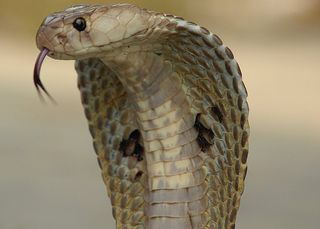
Cobras, with their threatening hoods and intimidating upright postures, are some of the almost iconic snakes on World. Their elegance, prideful opinion and venomous bite have made them both respected and feared.
"Cobras occur throughout Africa, the Middle East, India, Southeast Asia, and Republic of indonesia," said Sara Viernum, a herpetologist based in Madison, Wisconsin. The word comes from the Portuguesecobra de capello, which means "hooded snake."
There is some disagreement about what exactly a cobra is, and the number of cobra species ranges from 28 to about 270 depending on how a cobra is divers. Genetically, "true" cobras are members of the genusNaja, but according to Viernum, oftentimes "the name cobra references several species of snakes, almost of which are in the venomous ophidian family unit Elapidae. Elpididae includes other snakes similar coral snakes, kraits and mambas." Many of these snakes either possess hoods or the power to raise the upper office of their torso.
Cobra characteristics
Cobras are Elapids, a type of poisonous serpent with hollow fangs fixed to the top jaw at the front of the rima oris. These snakes cannot hold their fangs down on prey and then they inject venom through their fangs, according to the San Diego Zoo. They have an excellent sense of smell and night vision. In addition to their trademark hoods, cobras have circular pupils and smooth scales.
Colors vary widely from species to species. There are red, yellow, black, mottled, banded and many other colors and patterns of cobra.
Cobras are large snakes; many species reach more than 6 feet long (2 meters). According to Greatcoat Ophidian Conservation, the forest cobra is the largest true cobra, reaching 10 feet (3 1000), and Ashe's spitting cobra is 9 anxiety (two.7 m), making it the world's largest spitting cobra. The smallest species is the Mozambique spitting cobra, which is about 4 feet long (1.2 m). King cobras, the longest of all venomous snakes, can reach 18 feet (5.5 grand).
"The most well-known distinctive physical characteristic of cobras is their hood," said Viernum. "Hooding occurs when the snake spreads out its neck ribs forming a flattened, widened department of its trunk near the caput." This creates a stunning, and threatening, spectacle.
Habitat
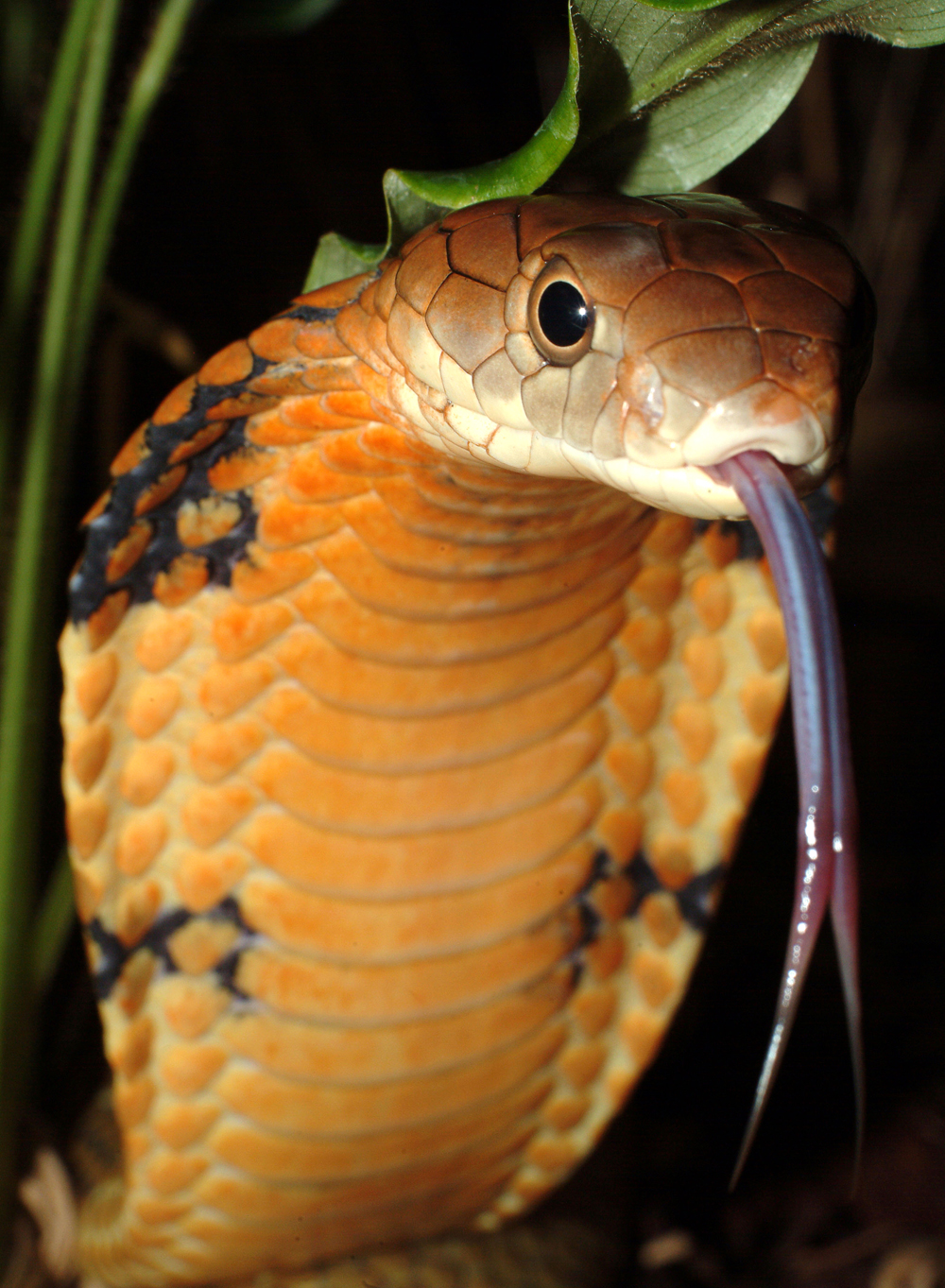
Co-ordinate to Cobras by Sylvia A. Johnson (Lerner, 2006), cobras typically live in hot, tropical areas but are also institute in savannahs, grasslands, forests and farming areas in Africa and Southern Asia. They like to spend time undercover, under rocks and in trees.
Habits
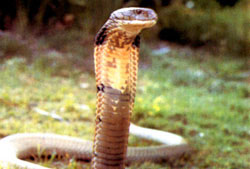
"The most distinctive behavioral characteristics of cobras are their defensive displays," said Viernum. "These include hooding, hissing, and raising the upper portion of their bodies to stand up erect. Most cobras tin can stand as tall every bit a third of their body length." In addition to signaling a willingness to assault, this behavior helps them search for food. Cobras may hiss loudly at predators and other threats, and some species also spit. "Spitting cobras are able to project venom from their fangs towards their perceived predators," said Viernum.
Cobras reproduce by laying eggs. Females typically lay twenty to 40 eggs at a time, which incubate between threescore and 80 days. According to India's SnakeWorld, cobras will stay well-nigh the eggs and defend them until they hatch. Wild boars and mongooses are known to steal cobra eggs.
The mongoose is the all-time-known enemy of the cobra. Co-ordinate to Cobras.org, mongooses have thick fur to protect against cobra fangs and oft defeat cobras in fights using their speed and agility. They tin bite the cobra's back before the snake tin defend itself. Cobras are also threatened from other snakes and humans.
Cobras are typically opportunistic hunters, chowing downwards on whatever casualty comes their way. Often, they eat birds, minor mammals, lizards, eggs, carrion and other snakes. They slither through the wilderness silently, following their casualty until they are fix to attack. According to the San Diego Zoo, almost cobras hunt at dawn or dusk, though some species fodder during the heat of the solar day.
Similar other snakes, cobras have a very slow metabolism that allows them to go for days or fifty-fifty months without feeding.
Cobra bite
"Cobra bites can be fatal, particularly if left untreated," said Viernum. Fortunately, antivenin is available and sometimes lives can as well exist saved with the use of an artificial respirator. Viernum explained cobras' neurotoxic venom'due south effects: "Like coral snakes, cobras accept potent neurotoxic venom, which acts on the nervous system. Symptoms from a neurotoxic cobra bite tin can include problems with vision, difficulty swallowing and speaking, skeletal muscle weakness, difficulty breathing, respiratory failure, airsickness, intestinal hurting, necrosis, and anticoagulation." [Related: 7 Shocking Snake Stories]
According to the University of Michigan, human victims may finish breathing but 30 minutes after beingness bitten by a cobra.
Some cobras, including all spitting cobras, have cytotoxic venom that attacks body tissue and causes astringent pain, swelling and possible necrosis (death of cells and tissue). According to the American Museum of Natural History, spitting cobras besides have the power to shoot venom from their fangs directly into the optics of the victim with terrifying accuracy. Venom in the optics tin lead to blindness if not washed out well.
Taxonomy/classification
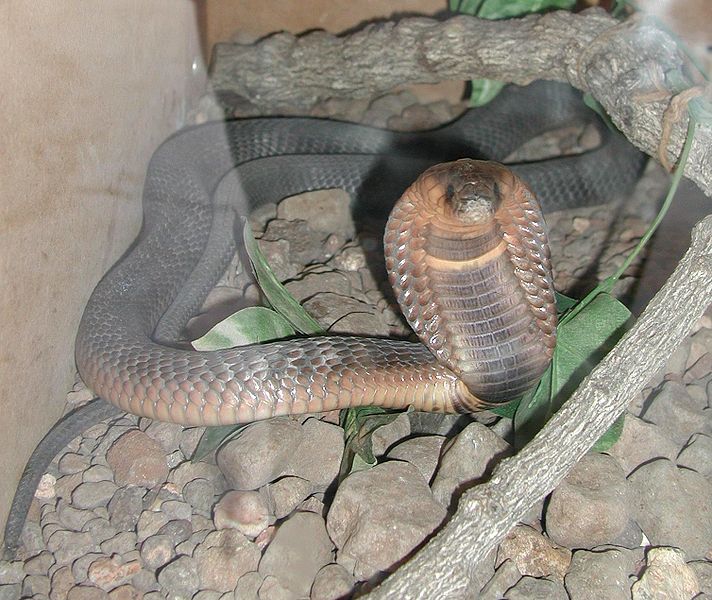
According to the Integrated Taxonomic Information System (ITIS), the taxonomy of "true" cobras is:
- Kingdom: Animalia
- Subkingdom: Bilateria
- Infrakingdom: Deuterostomia
- Phylum: Chordata
- Subphylum: Vertebrata
- Infraphylum: Gnathostomata
- Superclass: Tetrapoda
- Class: Reptilia
- Order: Squamata
- Suborder: Serpentes
- Infraorder: Alethinophidia
- Family: Elapidae
- Genus: Naja
- Species: 20, including Naja melanoleuca (wood cobra), Naja ashei (Ashe's spitting cobra), Naja mossambica (Mozambique cobra), Naja naja (Indian cobra)
King cobra
The king cobra is an example of a snake with "cobra" in its proper name, but it is not a fellow member of the Naja genus. The rex cobra (Ophiophagus hannah) is the only fellow member of its genus.
"The king cobra is the longest species of venomous snake in the world," said Viernum. Though they can attain lengths of up to 18 feet, Viernum said, their average length is 10 to 13 anxiety. Still, when they rear up the front third of their body under threat, the "stance tin can be quite high." An particularly long snake could be as alpine equally a person, meaning that an angry male monarch cobra could literally look yous in the middle.
National Geographic compares their warning hiss to a growing dog. Though there are other snakes with more potent venom, the amount of neurotoxin that a king cobra can emit in one bite is enough to kill 20 people — or ane elephant. Fortunately, king cobras are shy and avoid people.
King cobras are the just species of snake to build nests for their immature, which they guard ferociously. Co-ordinate to the Academy of Michigan Museum of Zoology's Animal Diverseness Spider web (ADW), nesting females may attack without provocation.
King cobras reside in copse, on country and in water, and are constitute in the rain forests, mangrove swamps, forests, and grasslands of southern Red china and Southeast Asia, according to the BBC. Their coloring varies from region to region.
According to National Geographic, king cobras are a popular species for serpent charmers in Southern asia, though the cobras cannot actually hear the music (being deaf to ambient noise). They are enticed past the shape and move of the flute.
Boosted resource
- Cape Ophidian Conservation: The Ultimate Cobra Snake FactsGuide
- Animal Diversity Web: King Cobra
- ADW: Indian Cobra
Source: https://www.livescience.com/43520-cobra-facts.html

Enregistrer un commentaire for "King Cobra Snakes Mommy and Baby King Cobra Snakes"